Skip to content
TeenWell

Lesson 2.4 of 4

Decision-Making & Peer Pressure

How do I make my own call when everyone around me is doing something else?

Lesson slides

8 slides Download PDF (1.5 MB)

  1. Slide 1: Decision-Making & Peer Pressure
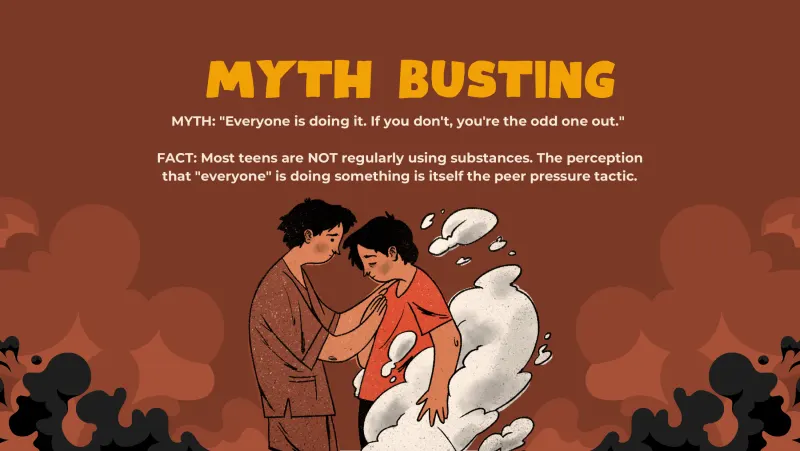
  2. Slide 2: MYTH BUSTing MYTH: "Everyone is doing it. If you don't, you're the odd one out." FACT: Most teens are NOT regularly using substances. The perception that "everyone" is doing som…
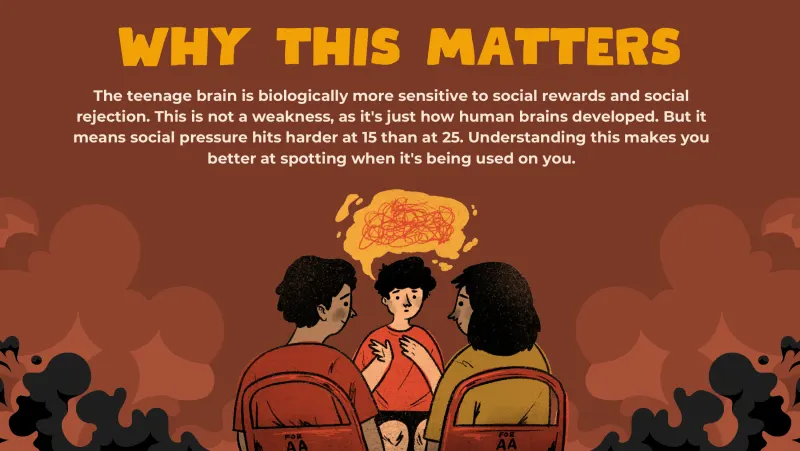
  3. Slide 3: WHY THIS MATTERS The teenage brain is biologically more sensitive to social rewards and social rejection. This is not a weakness, as it's just how human brains developed. But it…
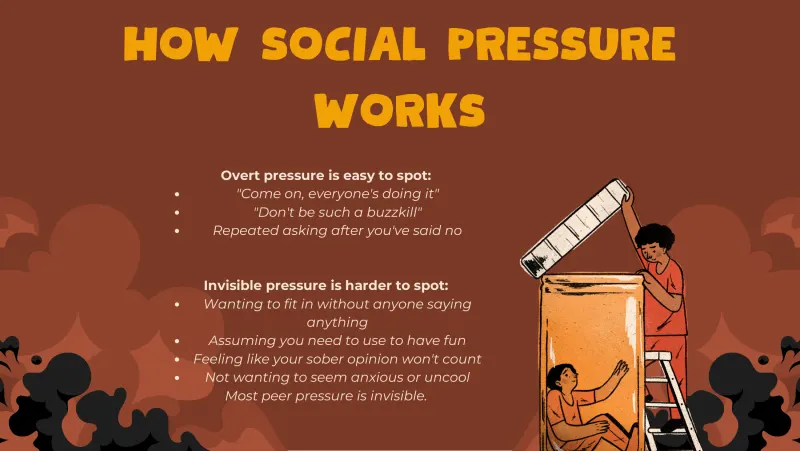
  4. Slide 4: HOW SOCIAL PRESSURE WORKS Overt pressure is easy to spot: "Come on, everyone's doing it" "Don't be such a buzzkill" Repeated asking after you've said no Invisible pressure is ha…
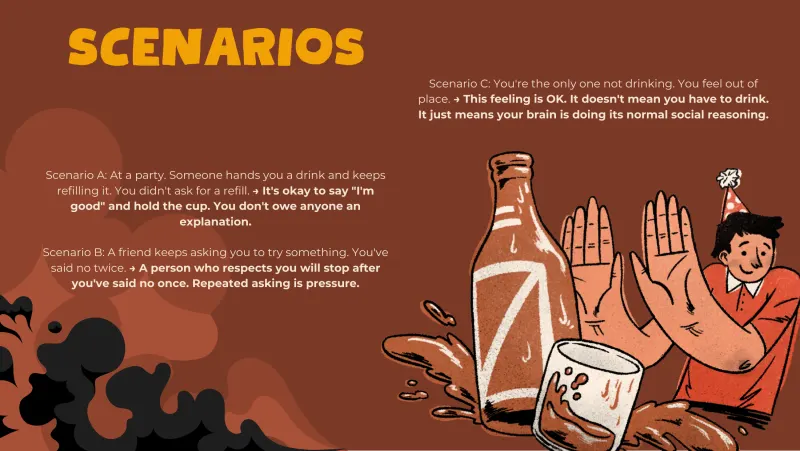
  5. Slide 5: SCENARIOS Scenario C: You're the only one not drinking. You feel out of place. → This feeling is OK. It doesn't mean you have to drink. It just means your brain is doing its nor…
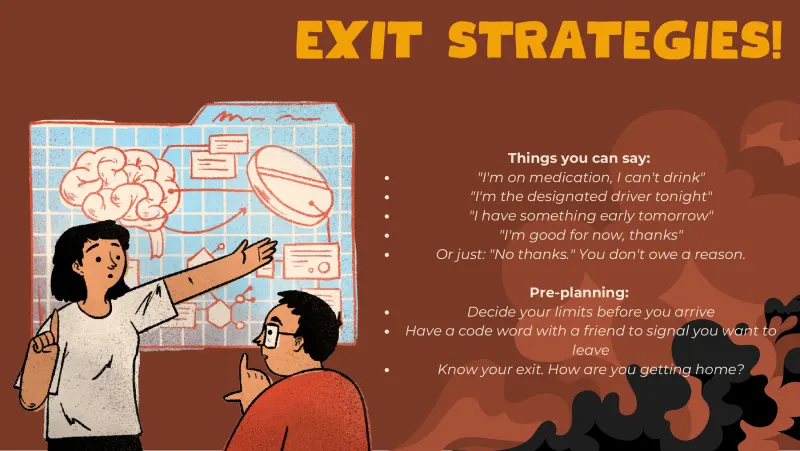
  6. Slide 6: EXIT STRATEGIES! Things you can say: "I'm on medication, I can't drink" "I'm the designated driver tonight" "I have something early tomorrow" "I'm good for now, thanks" Or just:…
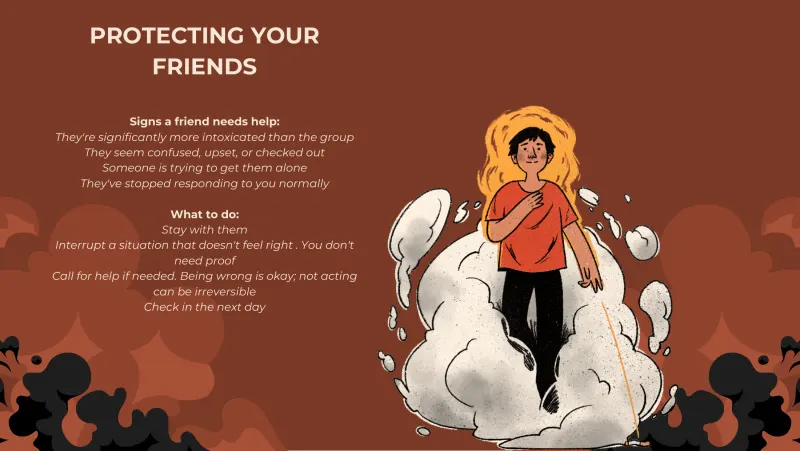
  7. Slide 7: PROTECTING YOUR FRIENDS Signs a friend needs help: They're significantly more intoxicated than the group They seem confused, upset, or checked out Someone is trying to get them …
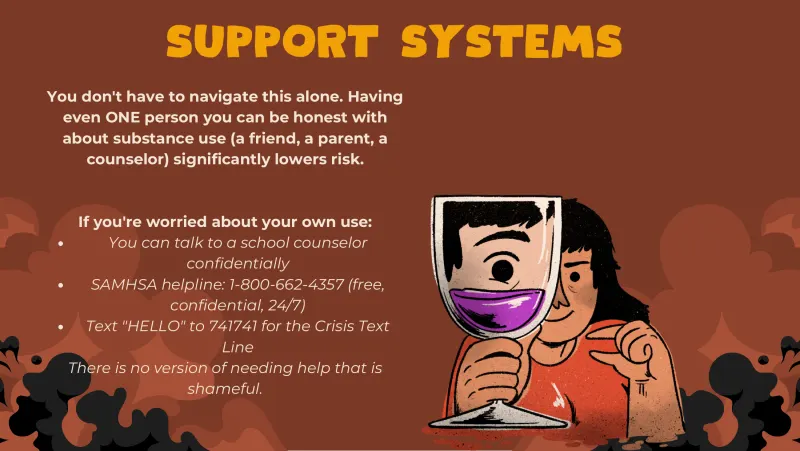
  8. Slide 8: SUPPORT SYSTEMS You don't have to navigate this alone. Having even ONE person you can be honest with about substance use (a friend, a parent, a counselor) significantly lowers r…
Read these slides as text
  1. Slide 1. Decision-Making & Peer Pressure
  2. Slide 2. MYTH BUSTing MYTH: "Everyone is doing it. If you don't, you're the odd one out." FACT: Most teens are NOT regularly using substances. The perception that "everyone" is doing something is itself the peer pressure tactic.
  3. Slide 3. WHY THIS MATTERS The teenage brain is biologically more sensitive to social rewards and social rejection. This is not a weakness, as it's just how human brains developed. But it means social pressure hits harder at 15 than at 25. Understanding this makes you better at spotting when it's being used on you.
  4. Slide 4. HOW SOCIAL PRESSURE WORKS Overt pressure is easy to spot: "Come on, everyone's doing it" "Don't be such a buzzkill" Repeated asking after you've said no Invisible pressure is harder to spot: Wanting to fit in without anyone saying anything Assuming you need to use to have fun Feeling like your sober opinion won't count Not wanting to seem anxious or uncool Most peer pressure is invisible.
  5. Slide 5. SCENARIOS Scenario C: You're the only one not drinking. You feel out of place. → This feeling is OK. It doesn't mean you have to drink. It just means your brain is doing its normal social reasoning. Scenario A: At a party. Someone hands you a drink and keeps refilling it. You didn't ask for a refill. → It's okay to say "I'm good" and hold the cup. You don't owe anyone an explanation. Scenario B: A friend keeps asking you to try something. You've said no twice. → A person who respects you will stop after you've said no once. Repeated asking is pressure.
  6. Slide 6. EXIT STRATEGIES! Things you can say: "I'm on medication, I can't drink" "I'm the designated driver tonight" "I have something early tomorrow" "I'm good for now, thanks" Or just: "No thanks." You don't owe a reason. Pre-planning: Decide your limits before you arrive Have a code word with a friend to signal you want to leave Know your exit. How are you getting home?
  7. Slide 7. PROTECTING YOUR FRIENDS Signs a friend needs help: They're significantly more intoxicated than the group They seem confused, upset, or checked out Someone is trying to get them alone They've stopped responding to you normally What to do: Stay with them Interrupt a situation that doesn't feel right . You don't need proof Call for help if needed. Being wrong is okay; not acting can be irreversible Check in the next day
  8. Slide 8. SUPPORT SYSTEMS You don't have to navigate this alone. Having even ONE person you can be honest with about substance use (a friend, a parent, a counselor) significantly lowers risk. If you're worried about your own use: You can talk to a school counselor confidentially SAMHSA helpline: 1-800-662-4357 (free, confidential, 24/7) Text "HELLO" to 741741 for the Crisis Text Line There is no version of needing help that is shameful.

These slides were made by the TeenWell team for classroom use. Unlike the linked resources below, they are our own material.

Start here

Shortest reads first.

Talk to someone or find care

Lesson 4 of 4 in Substance Use & Awareness. TeenWell doesn't write health information. Every link above goes to the organization that does.