Skip to content
TeenWell

Lesson 2.1 of 4

Vaping, Nicotine & Cannabis

What do vapes and weed actually do to a body that's still developing?

Lesson slides

8 slides Download PDF (1.2 MB)

  1. Slide 1: Vapin g, Nic ot in e, an d C an na bi s
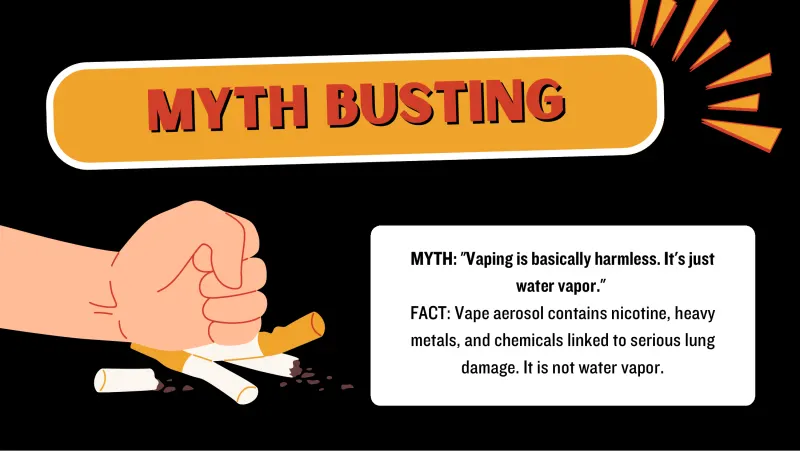
  2. Slide 2: MYTH BUSTING MYTH: "Vaping is basically harmless. It's just water vapor." FACT: Vape aerosol contains nicotine, heavy metals, and chemicals linked to serious lung damage. It is …
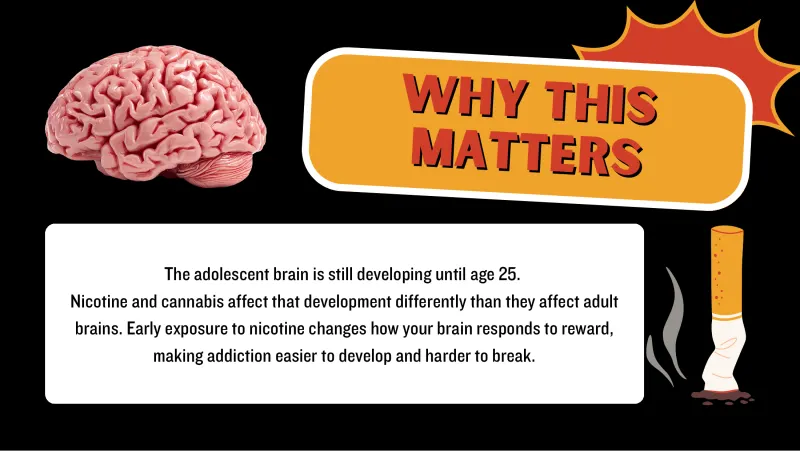
  3. Slide 3: WHY THIS MATTERS The adolescent brain is still developing until age 25. Nicotine and cannabis affect that development differently than they affect adult brains. Early exposure t…
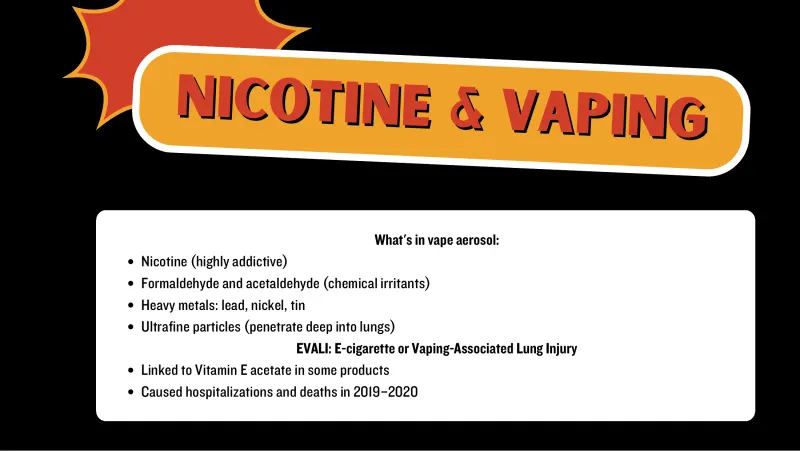
  4. Slide 4: NICOTINE & VAPING What's in vape aerosol: Nicotine (highly addictive) Formaldehyde and acetaldehyde (chemical irritants) Heavy metals: lead, nickel, tin Ultrafine particles (pen…
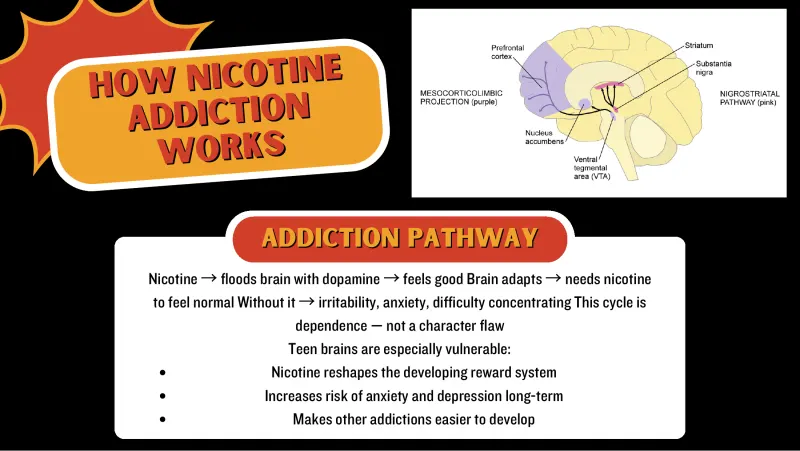
  5. Slide 5: OW N IC O TINE H ADDIC TIO N WORKS Addiction pathway → → → Nicotine floods brain with dopamine feels good Brain adapts needs nicotine → to feel normal Without it irritability, a…
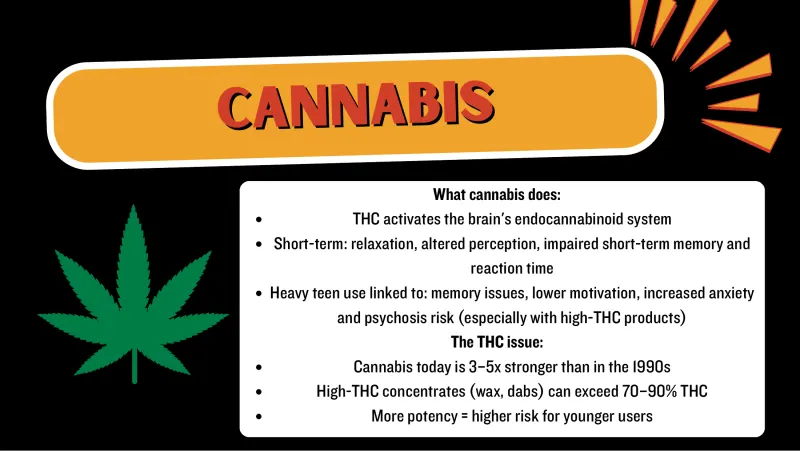
  6. Slide 6: CANNABIS What cannabis does: THC activates the brain's endocannabinoid system Short-term: relaxation, altered perception, impaired short-term memory and reaction time Heavy teen…
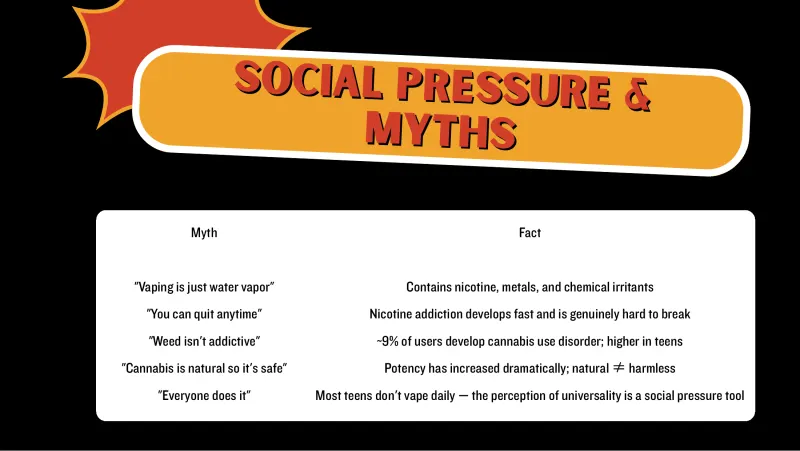
  7. Slide 7: SOCIAL PRESSURE & MYTHs Myth Fact "Vaping is just water vapor" Contains nicotine, metals, and chemical irritants "You can quit anytime" Nicotine addiction develops fast and is g…
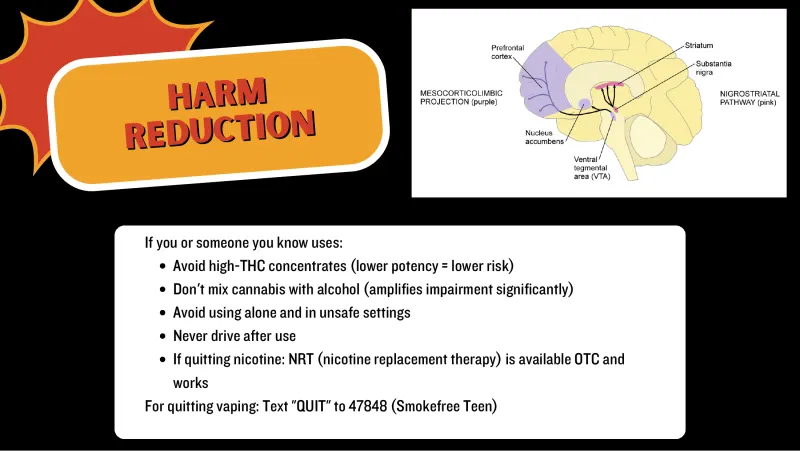
  8. Slide 8: HARM REDUCTION If you or someone you know uses: Avoid high-THC concentrates (lower potency = lower risk) Don't mix cannabis with alcohol (amplifies impairment significantly) Avo…
Read these slides as text
  1. Slide 1. Vapin g, Nic ot in e, an d C an na bi s
  2. Slide 2. MYTH BUSTING MYTH: "Vaping is basically harmless. It's just water vapor." FACT: Vape aerosol contains nicotine, heavy metals, and chemicals linked to serious lung damage. It is not water vapor.
  3. Slide 3. WHY THIS MATTERS The adolescent brain is still developing until age 25. Nicotine and cannabis affect that development differently than they affect adult brains. Early exposure to nicotine changes how your brain responds to reward, making addiction easier to develop and harder to break.
  4. Slide 4. NICOTINE & VAPING What's in vape aerosol: Nicotine (highly addictive) Formaldehyde and acetaldehyde (chemical irritants) Heavy metals: lead, nickel, tin Ultrafine particles (penetrate deep into lungs) EVALI: E-cigarette or Vaping-Associated Lung Injury Linked to Vitamin E acetate in some products Caused hospitalizations and deaths in 2019–2020
  5. Slide 5. OW N IC O TINE H ADDIC TIO N WORKS Addiction pathway → → → Nicotine floods brain with dopamine feels good Brain adapts needs nicotine → to feel normal Without it irritability, anxiety, difficulty concentrating This cycle is dependence — not a character flaw Teen brains are especially vulnerable: Nicotine reshapes the developing reward system Increases risk of anxiety and depression long-term Makes other addictions easier to develop
  6. Slide 6. CANNABIS What cannabis does: THC activates the brain's endocannabinoid system Short-term: relaxation, altered perception, impaired short-term memory and reaction time Heavy teen use linked to: memory issues, lower motivation, increased anxiety and psychosis risk (especially with high-THC products) The THC issue: Cannabis today is 3–5x stronger than in the 1990s High-THC concentrates (wax, dabs) can exceed 70–90% THC More potency = higher risk for younger users
  7. Slide 7. SOCIAL PRESSURE & MYTHs Myth Fact "Vaping is just water vapor" Contains nicotine, metals, and chemical irritants "You can quit anytime" Nicotine addiction develops fast and is genuinely hard to break "Weed isn't addictive" ~9% of users develop cannabis use disorder; higher in teens "Cannabis is natural so it's safe" Potency has increased dramatically; natural ≠ harmless "Everyone does it" Most teens don't vape daily — the perception of universality is a social pressure tool
  8. Slide 8. HARM REDUCTION If you or someone you know uses: Avoid high-THC concentrates (lower potency = lower risk) Don't mix cannabis with alcohol (amplifies impairment significantly) Avoid using alone and in unsafe settings Never drive after use If quitting nicotine: NRT (nicotine replacement therapy) is available OTC and works For quitting vaping: Text "QUIT" to 47848 (Smokefree Teen)

These slides were made by the TeenWell team for classroom use. Unlike the linked resources below, they are our own material.

Start here

Shortest reads first.

Go deeper

Talk to someone or find care

Lesson 1 of 4 in Substance Use & Awareness. TeenWell doesn't write health information. Every link above goes to the organization that does.